False mulberry
Also called Giant yellow mulberry · CorkwoodMyrianthus arboreus · Urticaceae family
A knobbly yellow compound fruit from a moisture-loving African tree. Its name invites a mulberry comparison, but the food part is the sweet pulp around its seeds.
Find it near DetroitGet to know it
False mulberry is a knobbly yellow fruit from tropical Africa, with sweet or tart pulp around its seeds. Its heart-shaped outline gives it another name in Ghana: “God’s heart.” Each large fruit is a cluster of smaller pieces joined together, each holding one seed.
What it is
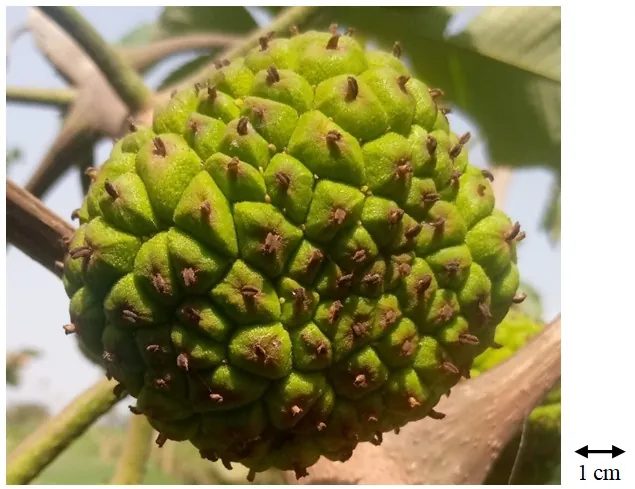
The fruit reaches about 10 cm (4 in) across. Its uneven surface comes from many small fruit units packed closely together, each holding a single seed. The edible part is the flesh around those seeds.
Sweetness is only part of its flavour: some pulp tastes tart. Around Kisangani, people suck out the juice and lick the seeds.
Where it comes from
Myrianthus arboreus grows across tropical Africa, from Guinea and Sierra Leone east to Ethiopia, and south to Angola and Tanzania. It belongs to wet places: rainforest, swamp forest and stream banks. It also grows in recovering forest, and farmers often keep the trees when clearing land for crops.
How it's eaten where it grows
Around Kisangani in DR Congo, the fruit is eaten for its sweet or sour juice and pulp. From Côte d’Ivoire to DR Congo, the seeds are also food after cooking.
The same tree supplies a separate leaf vegetable. Young leaves go into soups in West Africa; in Nigeria’s Delta and Edo States, they are among the popular local greens.
How it's grown
A short trunk divides into spreading branches, often supported by stilt-like roots. The large leaves spread into five to seven leaflets, and new leaves start out red. Male and female flowers grow on separate trees.
Monkeys and birds carry the seeds away from the parent tree. Seedlings also spring up around established trees in both forest and farmland, while farmers retain useful trees among their crops.
When and where you'll find it
In West Africa, fruits usually ripen from February to July; in Tanzania, they usually mature in February and March. Local markets around Kisangani sold the fruit in 1982–1983, alongside its use as a wild-gathered food in the surrounding villages.
Get it near Detroit
What it tastes like
As sweet as a banana, as mild as a peach≈
More about the taste
Sweet pulp surrounds the seeds inside a yellow compound fruit that can reach about ten centimeters across.
Sweet pulp surrounds the seeds inside a yellow compound fruit that can reach about ten centimeters across.
How to buy it
1EatSweet pulp
Eat
Sweet pulpThe sweet pulp around the seeds is the fruit eaten as food. Young leaves are eaten separately as a vegetable.
Detroit, Michigan
When it’s good hereUsual monthsJust arrivedAt their bestLast chanceAll yearWhere it is in its usual monthsToday, Oct 22Grown hereIn season in your stateShips fromIn season where it grows
Strange but trueNatureWhere the name came from
If you like False mulberry
Tastes alike
Sources
Photos · 1
Sources
False mulberry · Fruitopia · checked Sep 22, 2026