Durian
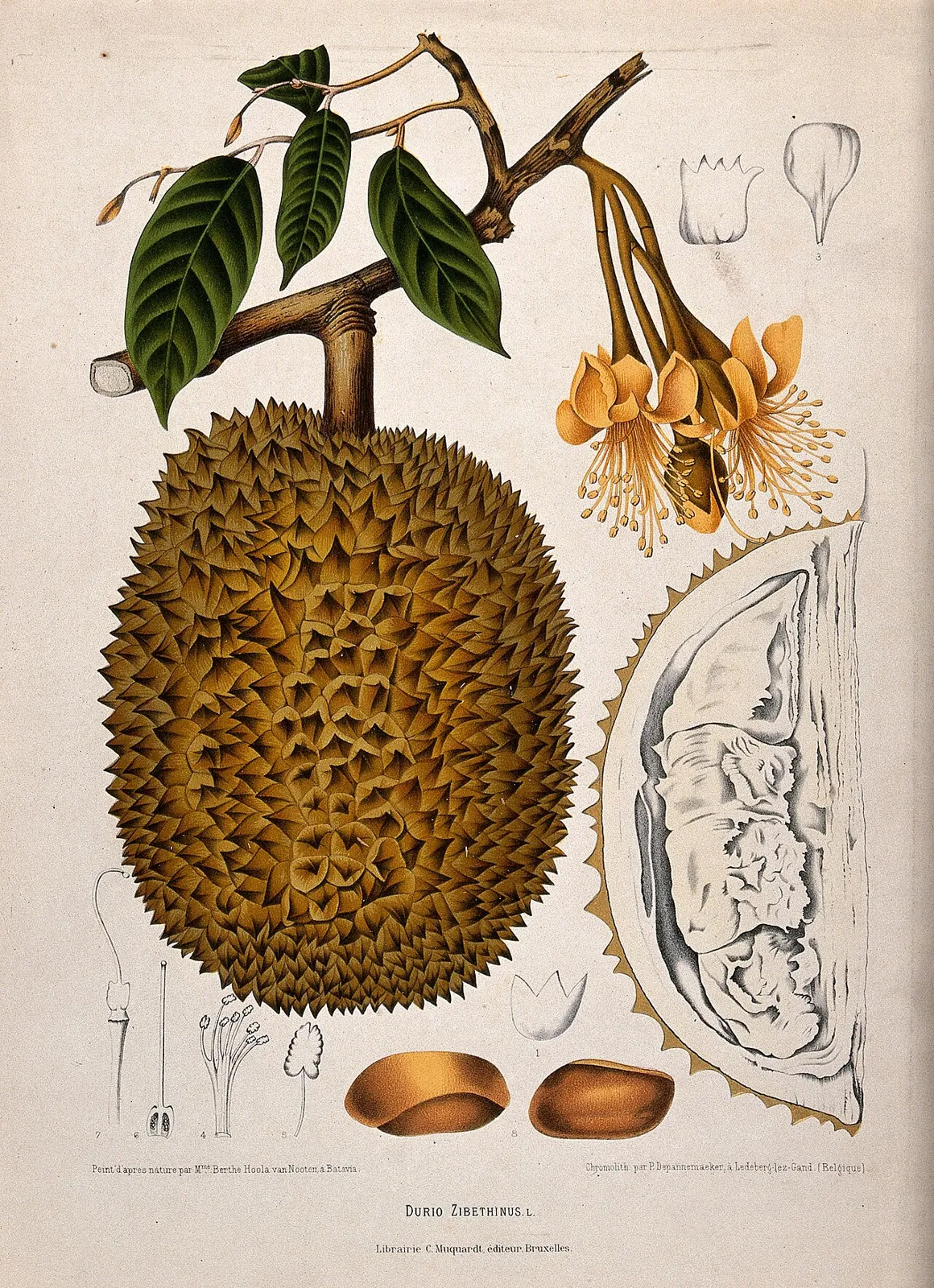
Also called DurionDurio zibethinus · Malvaceae family
Start with the custard-like flesh, then compare a cold shake with a deliberately savory pesto.
Find it near DetroitGet to know it
Durian is Southeast Asia's thorny giant: one fruit can weigh up to 8 kg (18 lb). Inside its spiky husk lie pods of soft, sweet flesh as smooth as custard, with a smell that can suggest garlic, onion or strong cheese over a fruity background.
What it is
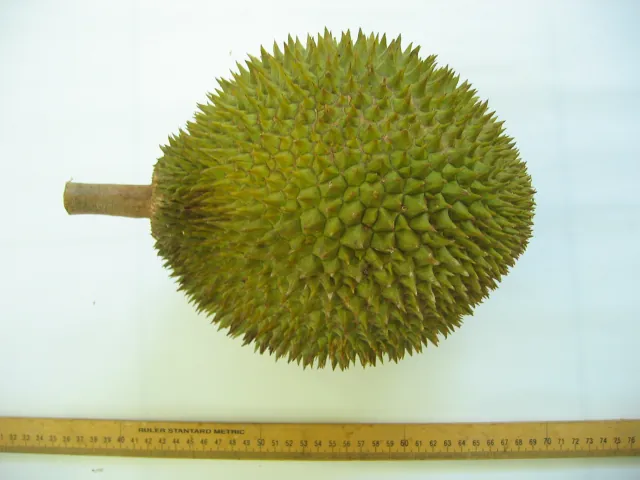
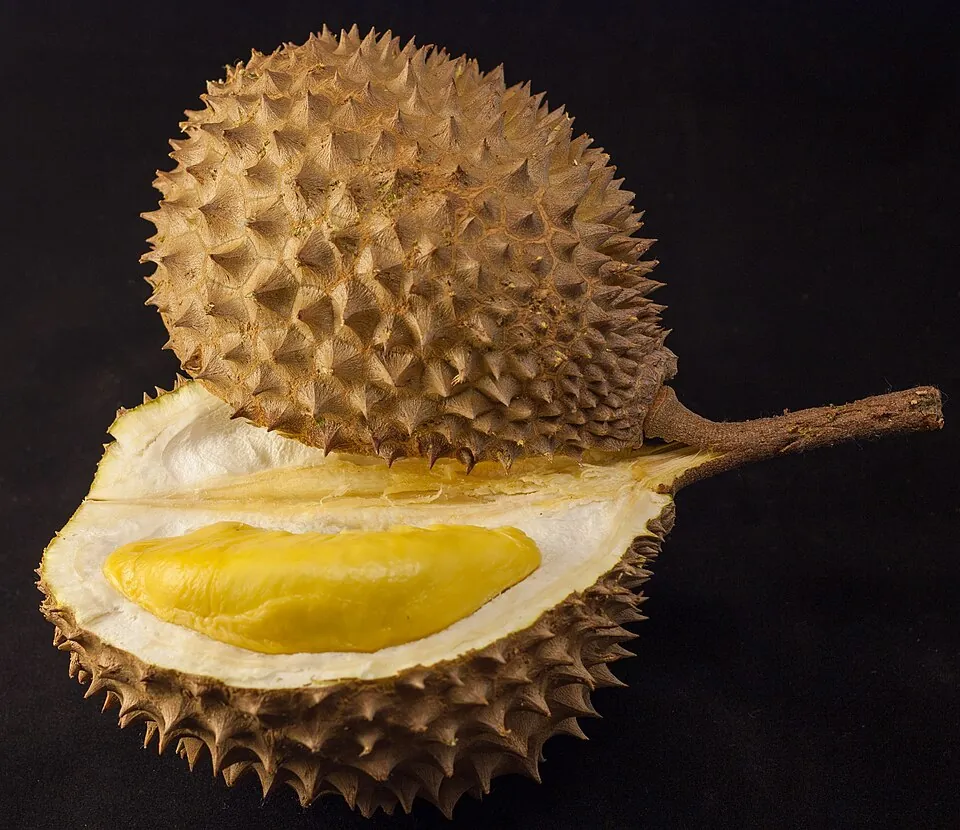
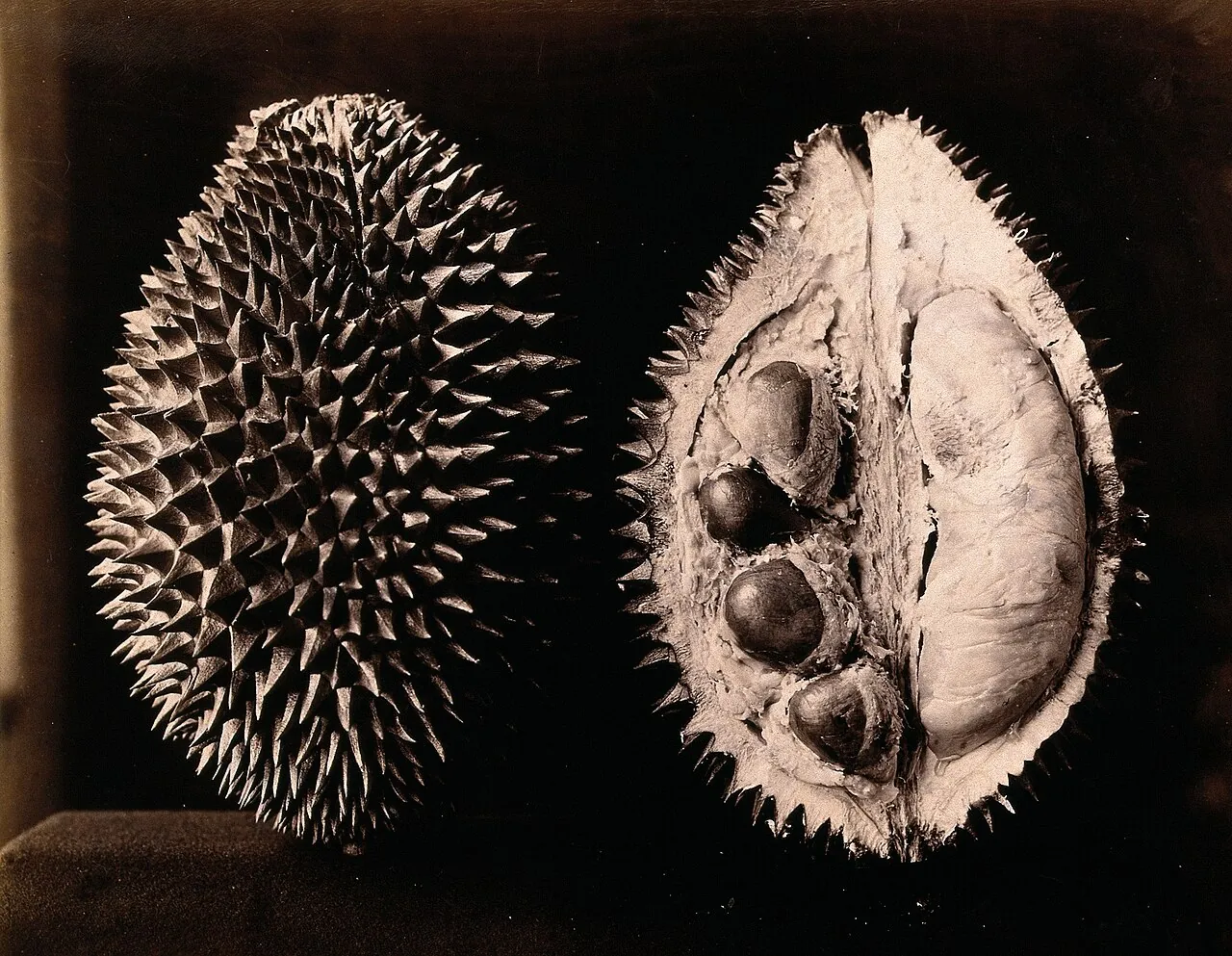
A durian is oval or round and up to 30 cm (12 in) long. Its thick, tough husk is covered in stout, sharp spines that hurt to hold without gloves. Inside, five compartments hold creamy-white, yellow, pink or orange flesh around 1 to 7 chestnut-like seeds. This flesh, the aril, is only 20 to 35% of the fruit's weight.
Some durians have almost no smell, others a strong one. The Thai variety Chanee smells stronger and is smaller than Monthong, the 'Golden Pillow', which weighs 2 to 5 kg (4½ to 11 lb).
Where it comes from
Durian is thought to be native to Borneo and Sumatra, and it is grown from Sri Lanka and southern India to New Guinea. Four hundred years ago, durians were carried from Lower to Upper Burma, where the royal palace prized them.
In 2018, Thailand was the world's biggest durian exporter. Chanthaburi province alone grows half of Thailand's crop. Malaysia's Musang King was found in Gua Musang, Kelantan, in the 1980s. China is the great buyer: in 2023 it imported 1.4 million tonnes, worth US$6.7 billion.
How it's eaten where it grows
In Thailand, durian is eaten fresh with sweet sticky rice, and Thais like the firmer flesh of less ripe fruit, while buyers in Singapore want it fully ripe. Malays salt the flesh to keep it all year for eating with rice. In Kelantan, fermented durian, tempoyak, is mixed with onion, chilli, lime juice and budu, an anchovy sauce, and eaten with rice. Javanese make the flesh into a sauce for rice, and in Palembang it is fermented in earthen pots.
In Vietnam, sinh tố sầu riêng is a thick durian shake made sweet and creamy with condensed milk. Durian also flavours ice cream, and its pulp is dried into 'durian cake'.
How it's grown
Durian grows on forest trees 27 to 40 m (90 to 130 ft) tall; grafted trees usually stay at 8 to 10 m (26 to 32 ft). It needs a hot, wet climate with plenty of rain. Grafted trees bear in 4 to 5 years, while seedlings in India take 9 to 12.
The fruit matures 3½ to 4½ months after it sets and falls to the ground when ripe. To keep it from falling, growers may tie the fruit to the branch or cut it at maturity, judging it by the days since flowering and by a hollow sound when they tap it with a stick or knife.
When and where you'll find it
In Thailand, durian is sold all year, with the peak usually from April to August. Around Cairns in Tropical North Queensland it usually turns up from February to July and in December.
A fallen durian is fully ripe in 2 to 4 days and past its best in 5 or 6. Ripe fruit and flesh are also frozen for export. Commercial supplies come from Thailand and Malaysia, and big cities far from the tropics have buyers who know it well. Where it grows, roadside and market stalls cut the fruit open and sell the flesh, with its seeds, in wrapped trays.
Sources · 8
- Australian Tropical Foodsaustraliantropicalfoods.comOther pages2
- Morton, Fruits of Warm Climates (1987)hort.purdue.edu
- National Parks Board Singaporenparks.gov.sg
- PROSEAprosea.prota4u.org
- Thailand Department of Agricultural Extensiondoae.go.th
- University of Hawaiʻi CTAHRctahr.hawaii.edu
- Wikipediaen.wikipedia.org
- Wok and Kinwokandkin.com
Get it near Detroit
What it tastes like
As soft as a banana, as mild as a peach≈
More about the taste
Durian has smooth, custard-like flesh, often sweet, with aromas that can suggest onion, garlic or strong cheese against a fruity background. Intensity varies from fruit to fruit.
Durian's aroma ranges from mild to strong, with garlic-, onion- or cheese-like notes against a fruity background, and sweet, custard-like flesh. Chanee tends to have a stronger aroma than Monthong.
A tasting invitation
Write separate notes for aroma, sweetness, bitterness and texture. Try a second named variety before deciding that one sample defines durian. Comparisons such as custard or onion are useful tasting language, but different fruit can taste quite different.
Choose, ripen, store, eat
1ChooseVariety and harvest stage
Look for
- Variety and harvest stage
Ignore
- Tapping
- Husk color
For a whole durian, ask the seller about the variety and harvest stage — tapping or husk color alone isn't a reliable way to judge it.
2RipenRipens after picking2–4 days
Ripens after pickingChanee2–4 daysMonthong4–6 daysRipening time varies by variety: harvested Chanee durian typically takes about two to four days, Monthong four to six.
3StoreFreezer, frozen pulp
- FreezerFrozen pulpPackage instructions
For frozen durian pulp, follow the package's storage and thawing instructions.
4EatAril · not husk, seeds
Eat
ArilNot eaten
HuskSeedsThe soft aril around the seeds is the edible part; the spiny husk and the seeds themselves are not eaten.
More tips
A useful detail The edible part is the pulpy aril around the seeds, inside a segmented, spiny capsule. Ripening can be uneven, leaving part of the flesh hard and poorly flavored even in one fruit.
Worth knowing
- Named durians are a good starting point, and preferences for aroma and texture differ widely.
- A durian's eating window depends on its variety and when it was harvested.
Detroit, Michigan
When it’s good hereUsual monthsJust arrivedAt their bestLast chanceAll yearWhere it is in its usual monthsToday, Oct 22Grown hereIn season in your stateShips fromIn season where it grows
14 growing areas, 5 countriesUsual monthsOur estimated monthsToday, Oct 22

- Chanthaburi
- Chiang Mai +1
- East Java
- Hawaii
- Johor
- Malaysia
- Northern Territory
- Pahang
- Queensland
- You
3 of 6 areas · October
Growing areas by country
- Thailand5
- Malaysia4
- Australia2
- Indonesia2
- United States1
In Thailand, durian is harvested with the stem attached, and retailers wrap the stem in leaf or paper to slow wilting. Fruit that's collected after falling naturally has a shorter handling life and a higher risk of injury.
216 varieties
- No variety photo yetMDUR88
- Taste
- high
- No variety photo yetMon Thong/ Bantal Mas
- Taste
- high
- Feel
- firm
- Texture
- creamy
- No variety photo yetTuan Mek Hijau/ Beserah
- Taste
- high
- Scent
- aroma yang kuat Malaysia
- Feel
- firm Malaysia
 D24
- Taste
- high
- Scent
- beraroma kuat Malaysia
- Feel
- firm Malaysia
- No variety photo yetMDUR78
- Taste
- high
- No variety photo yetMDUR79
- Taste
- high
28 names in 14 languages
- durenroot
- ಡ್ಯುರಿಯೊ ಜಿಬೆಥಿನಸ್Kannada
Cook it
How to serve it first
For a first tasting, buy a small portion of prepared flesh from a knowledgeable seller. Taste it plain before combining it with anything else. This also makes the experience easier to organize than learning to open a large spiny fruit at the table.
5 durian festivalsUsual monthToday, Oct 22
Strange but trueHistoryScienceNatureWhere the name came fromCustoms and cultureFood and drinkPeopleA record
If you like Durian
Tastes alike
Same plant family
Nutrition, sources
Nutrition
Durian, raw or frozen · per 100 g
- Carbohydrate
- 27 g
- Fiber
- 3.8 g
- Protein
- 1.5 g
- Fat
- 5.3 g
- Vitamin C
- 20 mg
- Potassium
- 436 mg
Sources
Durian · Fruitopia · checked Sep 21, 2026