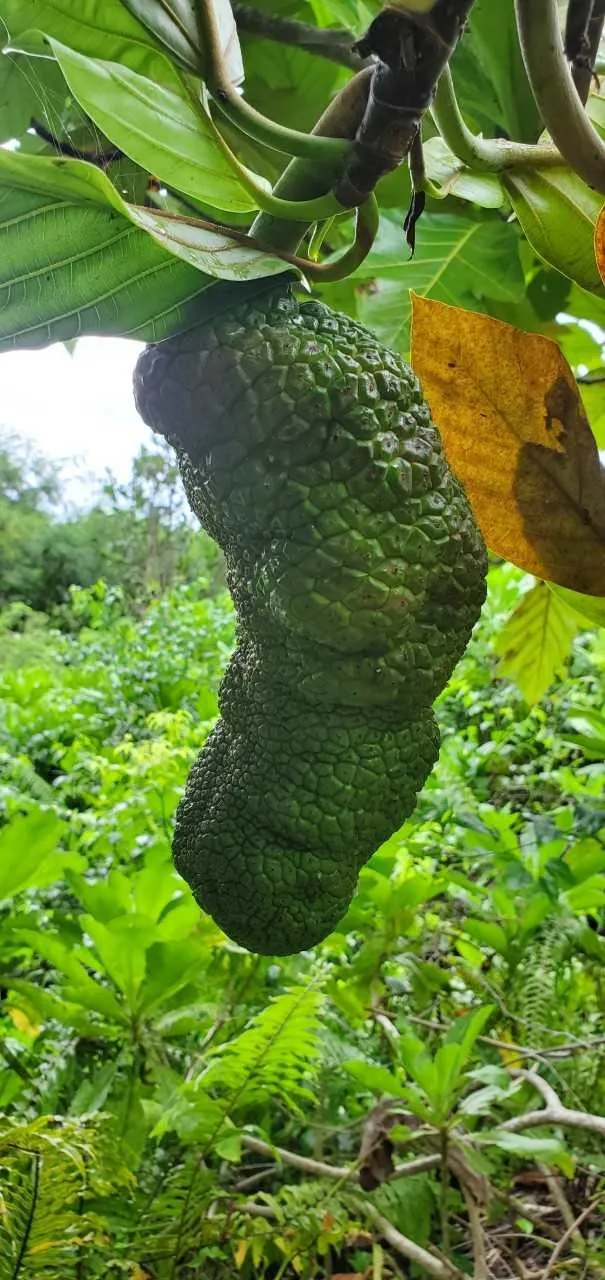
Dugdug
Artocarpus mariannensis · Moraceae family
A seeded breadfruit relative with a distinct Micronesian identity and food tradition.
Find it near DetroitGet to know it
Dugdug is a seeded breadfruit from the Mariana Islands, with yellow flesh and large seeds that taste a little like chestnuts when cooked. On Guam those seeds are called hutu, and people boil them or roast them over a fire.
What it is
The fruit is about 15 cm (6 in) long, often kidney-shaped or uneven, with dark green skin that stays green when mature. Inside, the ripe flesh is deep yellow, with a sweet smell and taste.
Each fruit holds up to 15 shiny, dark-brown seeds, about 1.5 cm (0.6 in) long. The tree also looks different from seedless breadfruit: its leaves are smaller, with shallower cuts around the edges.
Where it comes from
Dugdug is native to the limestone and ravine forests of the Mariana Islands, including Guam, and of Palau. It also grows in the Federated States of Micronesia and Hawai‘i.
This wild relative has crossed naturally with common breadfruit. Their offspring include both seeded and seedless varieties, all known as breadfruit. A seed inside a breadfruit therefore does not, by itself, make the fruit dugdug. On Guam, the tree’s wood and other parts also have a place in the history of canoe building.
How it's eaten where it grows
On Guam, cooked hutu is a snack shared with family, friends and colleagues. Boiling and fire-roasting are familiar ways to prepare it. One Guam cook also pairs them with coconut in home recipes.
For hutu-chocolate paste, the seeds boil for 25 minutes before their skins come off. They go into a food processor with melted chocolate, coconut oil, grated fresh coconut, plant-based milk and salt. Hutu-coconut bread uses ground boiled seeds in a batter with flour, grated coconut, eggs, baking powder and coconut oil. Both preparations start with the same cooked seed as the plain snack.
How it's grown
Dugdug grows into a large tree, typically 8–20 m (25–65 ft) tall. Growers raise it from seed, and trees begin to fruit at about five years old. Young plants grow best in partial shade.
Its tolerance of salty, coral-based soils suits tropical islands. It can also withstand a few months of drought. On atolls, it is planted in home gardens, where its spreading canopy gives shade.
Sources · 5
- National Tropical Botanical Gardenntbg.orgOther pages2
- Pacific Daily News, Else Demeulenaereguampdn.comOther pages2
- Ragone and Manner, Species Profiles for Pacific Island Agroforestry (2006)agroforestry.org
- University of Guam, Native Plants of Guamuog.edu
- World Agroforestry, Agroforestree Databaseapps.worldagroforestry.org
Get it near Detroit
What it tastes like
As mild as a peach, no sweeter than a grapefruit≈
More about the taste
Cooked hutu, the seeds of dugdug, are enjoyed much like European chestnuts.
Choose, eat
1ChooseDugdug passes through distinct stages: full-sized, mature firm, and soft ripe
Dugdug passes through distinct stages: full-sized, mature firm, and soft ripe.
2EatSeeds
Eat
SeedsThe seeds, called hutu, are removed from the fruit, boiled, then peeled before being made into a paste.
Detroit, Michigan
When it’s good hereUsual monthsJust arrivedAt their bestLast chanceAll yearWhere it is in its usual monthsToday, Oct 22Grown hereIn season in your stateShips fromIn season where it grows
Cook it
Strange but trueNature
If you like Dugdug
Tastes alike
Close relatives
Sources
Photos · 1