Banana passion fruit
Also called Banana passionfruitPassiflora tripartita · Passifloraceae family
An Andean climbing fruit whose quality responds to growing conditions. Its banana comparison describes a familiar form, not a banana ancestry.
Find it near DetroitGet to know it
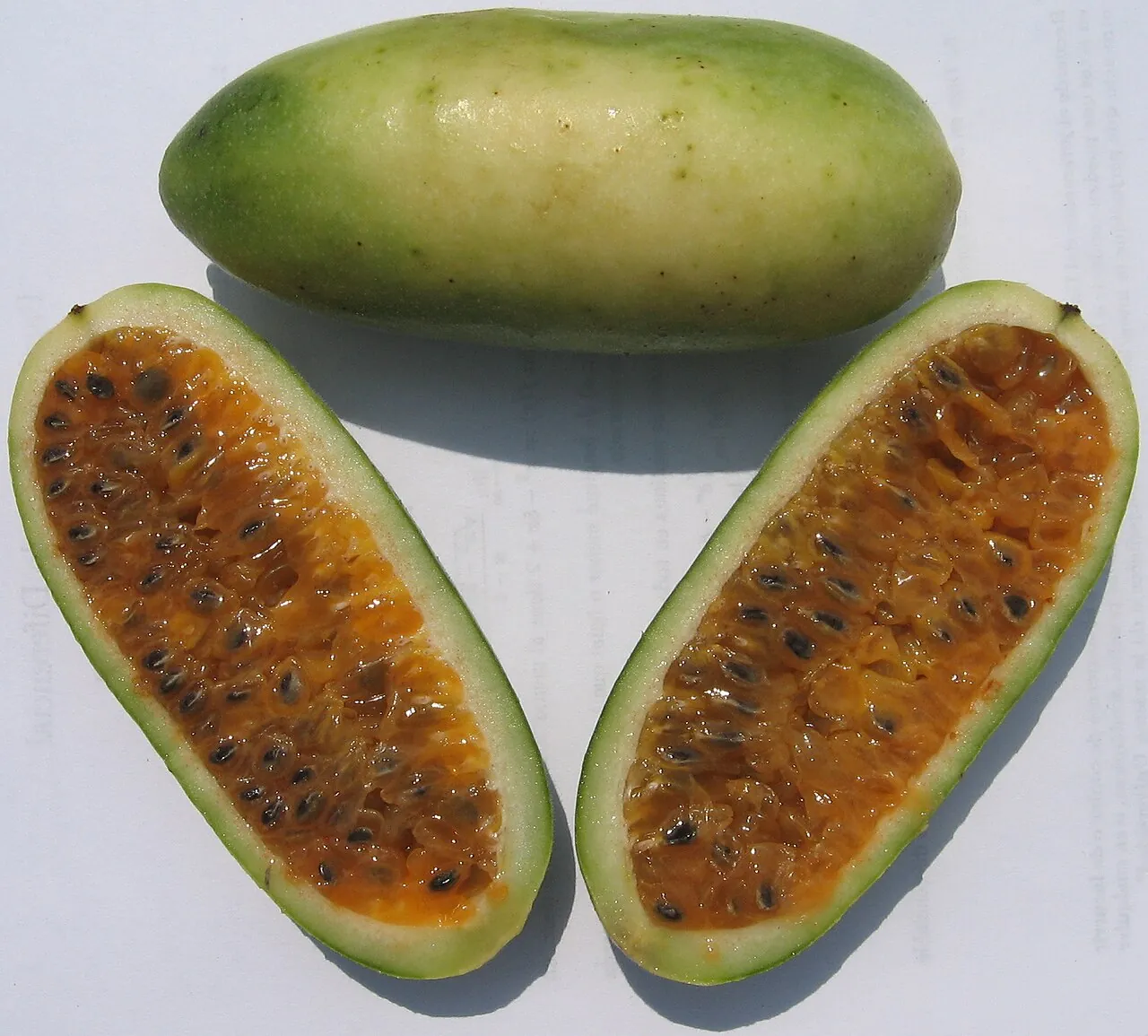
Banana passion fruit is a long, pale yellow fruit with fragrant, tart, salmon-coloured pulp around small black seeds. In Colombia it is curuba, served with milk and sugar or turned into a light, airy dessert called esponjado de curuba.
What it is
The fruit is about 5–12 cm (2–4.7 in) long and 3–4 cm (1.2–1.6 in) wide, and weighs about 50–150 g (2–5 oz). Its thick, leathery skin is whitish yellow and covered in fine down. Inside, strongly scented, sour, salmon-coloured pulp surrounds small, flat black seeds.
This Andean curuba is Passiflora tripartita var. mollissima, part of the passionflower family. Cut the fruit in half and scoop the pulp out with a spoon.
Where it comes from
Curuba comes from the Andes. It grows wild in Andean valleys from Venezuela and eastern Colombia to Bolivia and Peru, and was probably domesticated only shortly before the Spanish Conquest.
In Colombia, commercial plantings run along the Andes at about 2,000–3,200 m (6,600–10,500 ft). In Antioquia it grows in the cold-climate country around the village of Yarumal, in Sonsón. Far from home, New Zealand has grown it more or less commercially for several decades.
How it's eaten where it grows
In Colombia the seeds are strained out and the pulp is served with milk and sugar, or set in gelatin desserts. In Bolivia the juice, mixed with aguardiente and sugar, is a pre-dinner cocktail; in Ecuador the pulp becomes ice cream.
Bogotá and Boyacá have esponjado de curuba, an airy mousse. The pulp is blended gently so the seeds don’t break and turn the juice bitter. The strained juice and sugar are folded into beaten egg whites with gelatin, then chilled in a mould or small dessert cups until firm.
How it's grown
Curuba is a vigorous climbing vine that reaches 6–7 m (20–23 ft). Seedlings go onto a horizontal trellis about 2 m (6.5 ft) high, and the first crop comes in about 2 years. In Colombia, a closely planted, well-tended vine can give 200–300 fruits a year.
The vine fruits only on new branches, so pruning renews its bearing wood. With good care a planting lasts about 10 years.
When and where you'll find it
In Colombia the vine fruits more or less all year. In Yarumal and nearby villages of Sonsón, harvest peaks usually come in December–January and July–August. In New Zealand the crop ripens from late March or early April to September or October.
The fruit ships well and keeps for a good while somewhere dry and not too cold. Frozen pulp travels farther: Goya makes 14 oz (397 g) packs for the freezer section, with no added sugar, for juices, shakes and ice cream.
Sources · 5
- El Rincón Colombiano, Esponjado de Curuba recipeelrinconcolombiano.com
- Goya, Curuba Fruit Pulpgoya.com
- Mayorga and colleagues, Journal of Applied Botany and Food Quality (2020)ojs.openagrar.de
- Morton, Fruits of Warm Climates (1987)hort.purdue.edu
- Óscar Alejandro Ocampo Gálvez, UNAD, Sonsón grower survey (2014)repository.unad.edu.co
Get it near Detroit
Sell fruit online? Add your business
What it tastes like
Crisper than a blueberry, as tart as a kiwifruit≈
More about the taste
In a Pasca, Colombia trial, fruit from the higher site was more acidic, while fruit from the lower site had higher soluble solids (sweetness).
How to buy it
1EatPulp, Juice
Eat
PulpJuiceThe pulp and juice are the edible parts.
Detroit, Michigan
When it’s good here
Season not documented for Michigan.
Cook it
Strange but trueHistoryNature
If you like Banana passion fruit
Tastes alike
Close relatives
Sources
Sources
Banana passion fruit · Fruitopia · checked Oct 2, 2026
- elrinconcolombiano.com /en/esponjado-de-curuba-colombian-banana-passionfruit-mousse/
- en.cocina-colombiana.com /recetas/beverages/curuba-sorbet
- goya.com /es/products/curuba-fruit-pulp
- ojs.openagrar.de /index.php/JABFQ/article/download/14709/14822
- repository.unad.edu.co /bitstream/handle/10596/2782/1?sequence=3