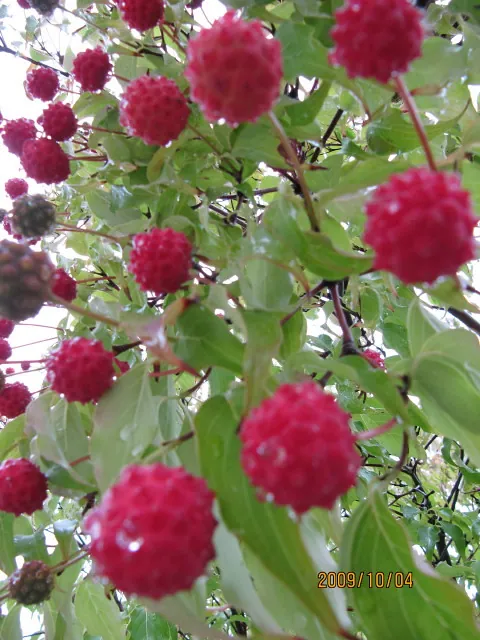
Kousa dogwood fruit
Also called Kousa dogwood · Japanese dogwood · KousaCornus kousa
Best known for its flowers, kousa dogwood also bears pink-red fruit that looks like raspberry but doesn't taste like one.
Find it near DetroitGet to know it
Kousa dogwood fruit looks like a knobbly pink raspberry, but inside is sweet, gooey pulp that can taste like American persimmon. The skin is gritty; the yellow-to-orange flesh is the part to squeeze out and eat.
What it is
This is the fruit of Cornus kousa, an Asian relative of America’s flowering dogwood. It is cherry-sized, with a rough skin and fairly large seeds for such a small fruit. An opening torn in the skin lets you squeeze out the pulp and spit out the seeds.
Flavour differs between trees. Around Greenville, South Carolina, some fruit tastes like pawpaw, some like American persimmon, and some is unpleasantly sweet.
Where it comes from
Kousa dogwood is native to Japan, Korea and China, where it grows in mountain forests, mixed woods, valleys and beside streams. It also has a long life as a garden tree abroad. In 1875, Parsons Nurseries in Flushing, New York, imported two forms sent from Japan by Thomas Hogg.
How it's eaten where it grows
In Japan, yamaboshi fruit becomes jam with sugar and lemon juice, or a fruit liqueur made by steeping it with rock sugar and clear spirits.
In Greenville, South Carolina, the Tyrant Farms kitchen turns the strained pulp into pudding cake with honey and whole wheat pastry flour. It has a texture between cake and crustless pumpkin pie. Removing the gritty skins and straining out the seeds leaves smooth pulp for baking.
How it's grown
The tree grows about 6–9 m (20–30 ft) tall, spreading into a rounded canopy as it matures. It grows in sun or light shade and likes acidic soil that drains well. Its leaves turn reddish-purple to scarlet in autumn before they drop, and older trunks have mottled, peeling bark.
When and where you'll find it
In Greenville, South Carolina, the fruit usually ripens from late August through mid-September. The harvest there comes from planted landscape trees. Ripe fruit feels slightly soft and comes away with a gentle pull. For cooking later, the pulp can be frozen after the skins and seeds are removed.
Get it near Detroit
Sell fruit online? Add your business
What it tastes like
Kousa dogwood pulp is sweet and gooey, but flavor varies a lot between individual trees: one might taste like pawpaw, another like American persimmon, another unpleasantly sweet.
The fruit is round, light red to pink outside, with fleshy yellow-orange flesh inside and a stone.
Choose, store, eat
1ChooseSlightly soft
Look for
- Slightly soft
- Releases with gentle pull
- Fallen naturally
Look for slightly soft fruit that releases with a gentle pull or has fallen naturally. Taste fruit from each tree before collecting a large batch, since flavor differs between trees.
2StoreFallen fruit can ferment quickly and attract yellow jackets
Fallen fruit can ferment quickly and attract yellow jackets.
3EatSmooth pulp · not gritty outer skin, seeds
Eat
Smooth pulpNot eaten
Gritty outer skinSeedsRemove the gritty outer skin, squeeze out the pulp, and strain away the seeds; only the smooth pulp is used in cooking.
Detroit, Michigan
When it’s good here
Season not documented for Michigan.
17 names in 8 languages
- قرانيا صينيةArabic
Cook it
Strange but trueScienceWhere the name came from
Sources
Photos · 1
Sources
Kousa dogwood fruit · Fruitopia · checked Sep 22, 2026
- burncoose.co.uk /site/plants.cfm?fromcategory=cat_id%3D2511&pl_id=1290
- flickr.com /photos/33037982@N04/4020007336/
- harvestandyarn.wordpress.com /2012/04/23/chai-kousa-dogwood-jam
- plants.ces.ncsu.edu /plants/cornus-kousa/
- tyrantfarms.com /introducing-kousa-dogwood-cornus-kousa-the-edible-dogwood/
- tyrantfarms.com /recipe-kousa-dogwood-pudding-cake