Service tree fruit
Also called Cormus domesticaSorbus domestica
An old European pome fruit that changes character after bletting, with apple-like and pear-like forms.
Find it near DetroitGet to know it
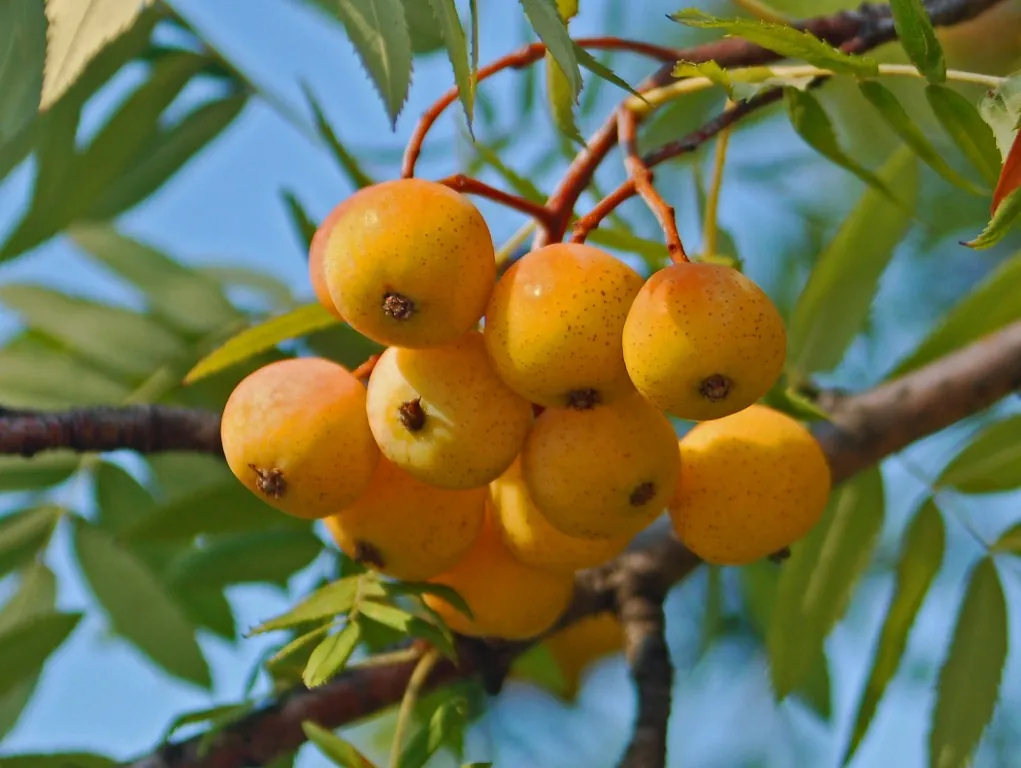
Service-tree fruits look like small apples or pears, but their first bite can pucker your mouth. Left to soften and turn brown, they develop creamy, edible pulp. This change is called bletting, the same softening that makes a medlar ready to eat.
What it is
Sorbus domestica belongs to the rose family. Its fruits are about 2–3 cm (0.8–1.2 in) across, in apple-shaped and pear-shaped forms. Before softening, the skin ranges from russet to greenish-red.
In France the fruits are called cormes. Firm fruit is intensely astringent, leaving a dry, puckering feeling in the mouth. Bletted fruit becomes soft and dark brown, with creamy pulp.
Where it comes from
The service tree’s natural range includes southern and central Europe, especially the Balkans, Italy and southern France. Its long history in cultivation has blurred the boundary between planted and wild trees. In the Pays de la Loire countryside of France, it grows in hedges and at woodland edges, and fine old trees still stand in farmyards.
How it's eaten where it grows
In Pays de la Loire, cormé is a cider-like drink made by fermenting softened cormes with water. German apple wine can also include service-tree fruit, known as Speierling.
Kronberger Speierlingstraum is a German dessert: crumbled sponge biscuits drizzled with service-tree brandy, a layer of service-tree purée, then mascarpone, soft fresh cheese and whipped cream, chilled for hours. Cinnamon finishes the top.
How it's grown
The service tree grows slowly to about 10–20 m (33–66 ft). It needs light and struggles when neighbouring trees crowd it out, but can grow on poor, stony soils. It produces little viable seed. New trees can instead be raised from root suckers, shoots that spring up from an existing tree’s roots.
When and where you'll find it
Cormes are an autumn fruit in Pays de la Loire, where they are usually gathered after the first frosts. Along the Mediterranean coast they can soften before frost arrives: the dark, soft stage is what matters for eating. Bottled apple wine offers another encounter; Kelterei Walther in Bruchköbel, Germany, makes Apfelwein Speierling.
Sources · 5
Get it near Detroit
Sell fruit online? Add your business
What it tastes like
Fresh fruit is strongly astringent and becomes edible after bletting, as with medlars.
Fresh fruit is strongly astringent and becomes edible after bletting, as with medlars.
Choose, ripen, eat
1ChooseVery soft, dark brown
Look for
- Very soft, dark brown
- Creamy pulp
Ignore
- Unbletted appearance
Ready-to-eat cormes are very soft and entirely dark brown, with creamy pulp. Firm yellow-orange fruit can be intensely astringent; color and softness matter more than an attractive unbletted appearance.
2RipenRipens after picking
Ripens after pickingOn the Mediterranean coast, service-tree fruit can soften (blet) before any frost; elsewhere, it's often picked after the first frosts.
3EatBletted fruit
Eat
Bletted fruitBletted fruit is used fresh and processed into marmalades, jams, jellies, juices and alcoholic drinks.
Detroit, Michigan
When it’s good here
Season not documented for Michigan.
28 names in 9 languages
Cook it
Strange but trueHistoryA myth, and the truthNatureCustoms and cultureFood and drinkA record
Sources
Photos · 1
Sources
Service tree fruit · Fruitopia · checked Sep 22, 2026
- flickr.com /photos/29882791@N02/8300454742/
- forest.jrc.ec.europa.eu /media/atlas/Sorbus_domestica.pdf
- fruitiers-rares.info /articles-A117a122/article118-cormes-Sorbus-domestica-Cormier.html
- herbaria.plants.ox.ac.uk /bol/plants400/Profiles/ST/Sorbusd
- pays-de-la-loire.chambres-agriculture.fr /actualites-1/detail-de-lactualite/les-essences-oubliees-du-bocage-zoom-sur-le-cormier-sorbus-domestica
- walther-kelterei.de
- walther-kelterei.de /products/apfelwein-speierling
- wildobst.info /wp-content/uploads/Faltblatt_Plakat_Speierling.pdf