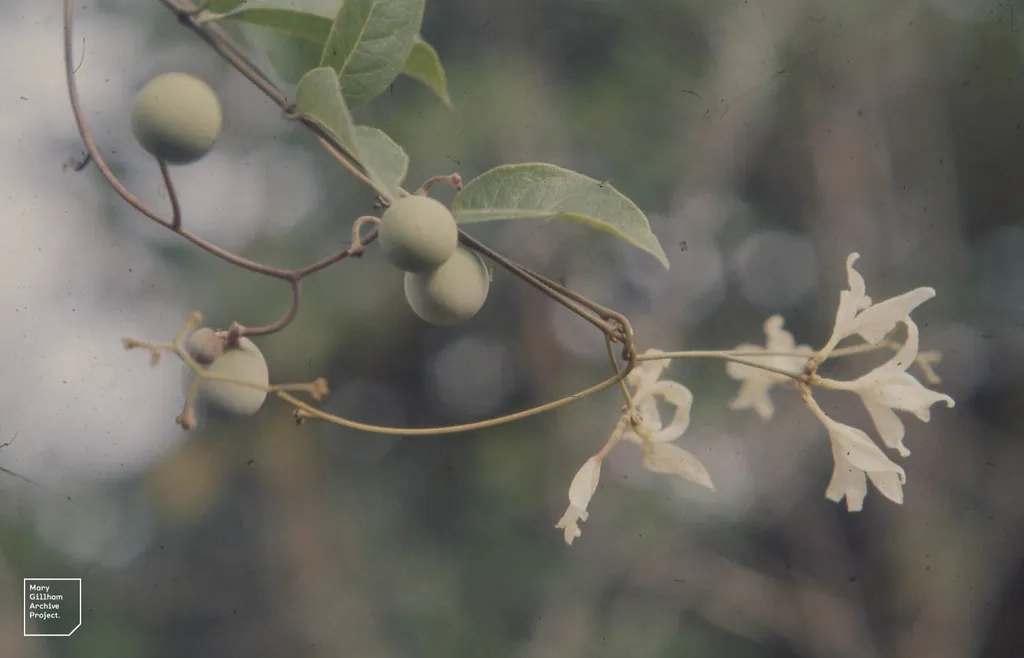
Sand apricot
Also called Muvhungo · Kirk's landolphia · RubbervineLandolphia kirkii
A southern African climbing fruit with a local food name and a still-thin modern tasting record.
Find it near DetroitGet to know it
Sand apricot is a hard-skinned African vine fruit with yellow, juicy pulp, sweet with a little tartness. Cut the ripe fruit in half to reach it: beneath the dull green shell, several seeds sit in the soft flesh.
What it is
Sand apricot is the fruit of Landolphia kirkii, also called rubber vine. The fruit is round or oval, with a hard, spotted skin that is dull green. It can reach 15 cm (6 in) across. Inside, four or five oval seeds sit in juicy yellow pulp; the flesh is eaten raw.
Where it comes from
Its home stretches through eastern and southern Africa, including Kenya, Tanzania, Malawi, Mozambique, Zambia and Zimbabwe, and reaches KwaZulu-Natal in South Africa. It also grows in the Democratic Republic of the Congo. In Tanzania, it grows around Tanga and Dar es Salaam and on the islands of Mafia and Zanzibar.
How it's eaten where it grows
In Tanzania, people gather the fruit from the wild and cut ripe ones in half for the juicy pulp, eaten raw: sweet with a slight tartness. Fresh fruits also go to local markets. Ripe fruits keep in the shade for several weeks.
How it's grown
The plant is an evergreen climber, sometimes growing as a shrub. Strong tendrils form from its flower-bearing branches, and the small white or creamy-yellow flowers are scented. It grows in forest, along forest edges and in miombo woodland and wet valleys. Seeds and cuttings can start new plants. In Tanzania, the fruit is gathered wild rather than grown as a crop.
When and where you'll find it
In Tanzania, the gathering season usually runs from March to June, and the fresh fruit is sold in local markets there. Swahili names include mmeru sukari and mpira; the English name rubber vine refers to the plant’s sticky white latex, used as a rubber substitute.
Get it near Detroit
Sell fruit online? Add your business
What it tastes like
In Tanzania, ripe Landolphia kirkii pulp is yellow, juicy, sweet and slightly acid — a regional food description, not a comparison with cultivated apricots.
How to buy it
1EatPulp
Eat
PulpIn Tanzania, ripe fruit is cut in half to reach the juicy pulp.
Detroit, Michigan
When it’s good here
Season not documented for Michigan.
Strange but trueHistory
Sources
Photos · 1