Membrillo de monte
Gustavia superba
Membrillo-de-monte has striking flowers and orange fruit tissue, though its food story is more modest than an enthusiastic tropical-fruit nickname might suggest.
Find it near DetroitGet to know it
Membrillo de monte is the yellow fruit of Gustavia superba, with orange flesh that people eat cooked. The tree is striking before the fruit arrives: large, fragrant flowers grow directly from its trunk and main branches.
What it is
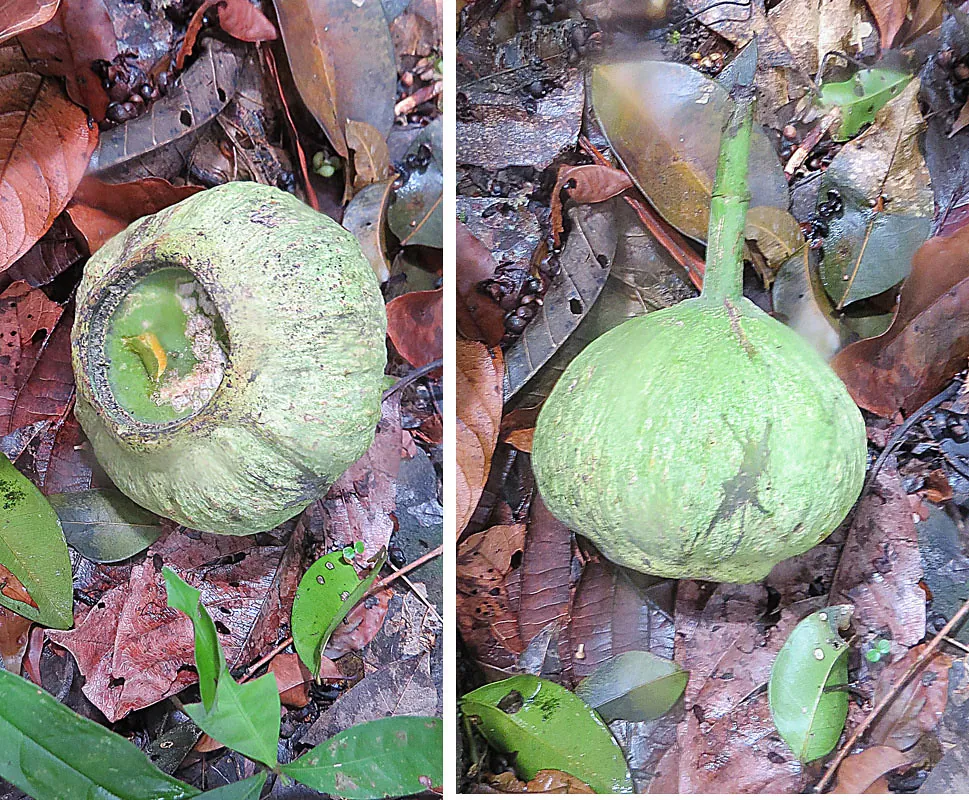
The fruit is rounded and slightly flattened, with a raised ring at the top. It reaches about 8 cm (3 in) long and 10 cm (4 in) across. Inside are orange flesh and large seeds. On Panama's Barro Colorado Island, fruits weigh roughly 150–600 g (5–21 oz). The cooked pulp is the food; the seeds have a persistent bitter taste.
Where it comes from
The tree grows in central Panama and northwestern Colombia, in moist lowland forest and places where vegetation has been disturbed. On Barro Colorado Island in Panama, it is common beneath the canopy of regrowing forest. People also grow it in family gardens for their own fruit and gather fruit from wild trees.
How it's eaten where it grows
In Colombia, the pulp is valued as a delicacy. It is usually eaten cooked: the orange flesh goes into soups, rice and meat dishes, giving them its colour and taste. It is the soft flesh around the seeds that is used; the large seeds themselves taste bitter.
How it's grown
The evergreen tree has few branches, with large leaves gathered at their tips. It suits warm, humid conditions and moist soil that drains well, in sun or light shade. It grows from seed, with germination taking about seven to nine weeks. Gardeners also plant it for its large, fragrant, waxy flowers.
When and where you'll find it
In Panama's Canal Zone, fruiting usually runs from April through August, from the end of the dry season into the early wet season. Home gardens and locally gathered wild fruit are ways people encounter membrillo in its home region. It is also grown as a flowering garden tree.
Get it near Detroit
What it tastes like
Cooked pulp is described as rich and savory, sometimes compared with meat, though older accounts are less enthusiastic about the flavor.
Mature fruit is yellow with orange mesocarp and large seeds.
Choose, eat
1ChooseShared name membrillo
Ignore
- Shared name membrillo
Seek a correctly identified prepared food rather than relying on the shared name membrillo, which is used for other fruits too.
2EatCooked orange pulp · not large seeds
Eat
Cooked orange pulpNot eaten
Large seedsThe orange pulp is eaten after cooking. Keep it separate from the large seeds, which are persistently bitter.
Detroit, Michigan
When it’s good hereUsual monthsJust arrivedAt their bestLast chanceAll yearWhere it is in its usual monthsToday, Oct 22Grown hereIn season in your stateShips fromIn season where it grows
Strange but trueNature
Sources
Photos · 1
Sources
Membrillo de monte · Fruitopia · checked Sep 22, 2026