Karaka fruit
Also called Karaka · New Zealand laurel · Karaka nutCorynocarpus laevigatus
Karaka connects fruit with a demanding history of food preparation and cultivated landscapes. Its flesh and kernel must be kept separate: the kernel is poisonous without specialized processing.
Find it near DetroitGet to know it
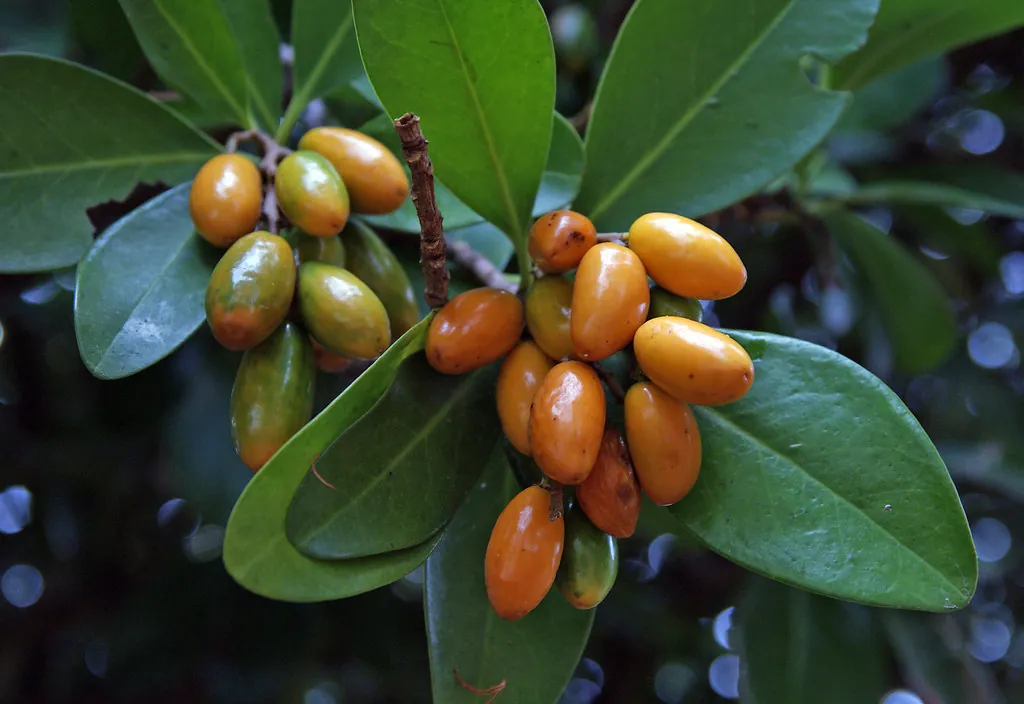
Karaka is an orange, oval fruit from Aotearoa New Zealand with a strong, sweet scent and flesh that recalls apricot. It holds an important place in Māori and Moriori food traditions. The raw kernel is poisonous; preparing it as food requires specialised traditional knowledge.
What it is
The fruit reaches about 4 cm (1.6 in) long. Under its skin is a thin layer of pale yellow to orange flesh, then a fibrous covering around one large kernel. The pulp has a strong apricot-like flavour, sometimes compared to ripe medlar. Flesh and kernel are different foods: the kernel needs extensive preparation before it can be eaten. As it ripens, the skin changes from green through yellow to orange.
Where it comes from
Karaka belongs to New Zealand’s coastal forests. Māori planted it widely as a food tree, carrying it far beyond its original northern range. Groves grew around villages, where the broad trees also shaded houses. Fruit travelled between communities as gifts: people on the Otago Peninsula received karaka from farther north. On the Chatham Islands, the tree is prized by Moriori.
How it's eaten where it grows
For Māori, dried, prepared karaka kernels were winter food, stored to help feed communities when other foods were scarce. Preparing them involved cooking and prolonged soaking, rather than simply cracking a nut. The practice continues around Kāwhia, East Cape and the Chatham Islands. The thin outer pulp was another food, with its own strong fruit flavour.
How it's grown
The tree reaches about 15 m (49 ft), with a wide crown of shiny, dark green leaves. It grows readily from fresh seed, but young plants are sensitive to frost and cold. Karaka groves were carefully tended: moss was regularly cleaned off the trees to make sure of a good fruiting season.
When and where you'll find it
Karaka usually fruits in New Zealand’s summer and autumn. On Rēkohu, the main Chatham Island, ripe fallen fruit is usually gathered in February and March, when its scent is strong. In Auckland, Cornwall Park has karaka trees near the Grotto, along Pūriri Drive and around the Belvedere.
Get it near Detroit
Sell fruit online? Add your business
What it tastes like
Ripe karaka fruit (kopi) is strongly, sweetly aromatic. The fully prepared kernel, after traditional processing, is said to taste like the smell of the ripe fruit -- the raw kernel itself is not eaten.
The flesh is pale yellow to orange, surrounding a fibrous inner covering.
Historical accounts compare the pulp's flavor to medlar or a strongly flavored apricot.
Choose, store, eat
1ChoosePale yellow to orange flesh
Look for
- Pale yellow to orange flesh
Ripe karaka fruit flesh is pale yellow to orange.
2StoreUnprocessed karaka kernels are not ready-to-eat
Unprocessed karaka kernels are not ready-to-eat; only fully prepared kernels are safe.
3EatFleshy outer part · not kernel
Eat
Fleshy outer partNot eaten
KernelOnly the fleshy outer part is edible raw; the kernel is poisonous unless prepared using specialized traditional detoxification methods.
Detroit, Michigan
When it’s good here
Season not documented for Michigan.
Cook it
Strange but trueHistoryA myth, and the truthNatureWhere the name came fromCustoms and cultureFood and drink
Sources
Photos · 1
Sources
Karaka fruit · Fruitopia · checked Sep 22, 2026
- cornwallpark.co.nz /whats-on/tree-of-the-month-karaka
- flickr.com /photos/88123769@N02/14247875482/
- nzpcn.org.nz /site/assets/files/0/16/207/corynocarpus-laevigatus.pdf
- rauropiwhakaoranga.landcareresearch.co.nz /names/1ea4d270-8489-4f93-a5e2-664976080dda
- thespinoff.co.nz /atea/14-02-2018/how-to-prepare-the-delicious-but-poisonous-karaka-berry
What we don't know yet
Visiting the park doesn't give permission to pick or taste the fruit there.