Jentik
Baccaurea polyneura · Phyllanthaceae family
A forest fruit that Aceh respondents valued enough to plant beside other crops.
Find it near DetroitGet to know it
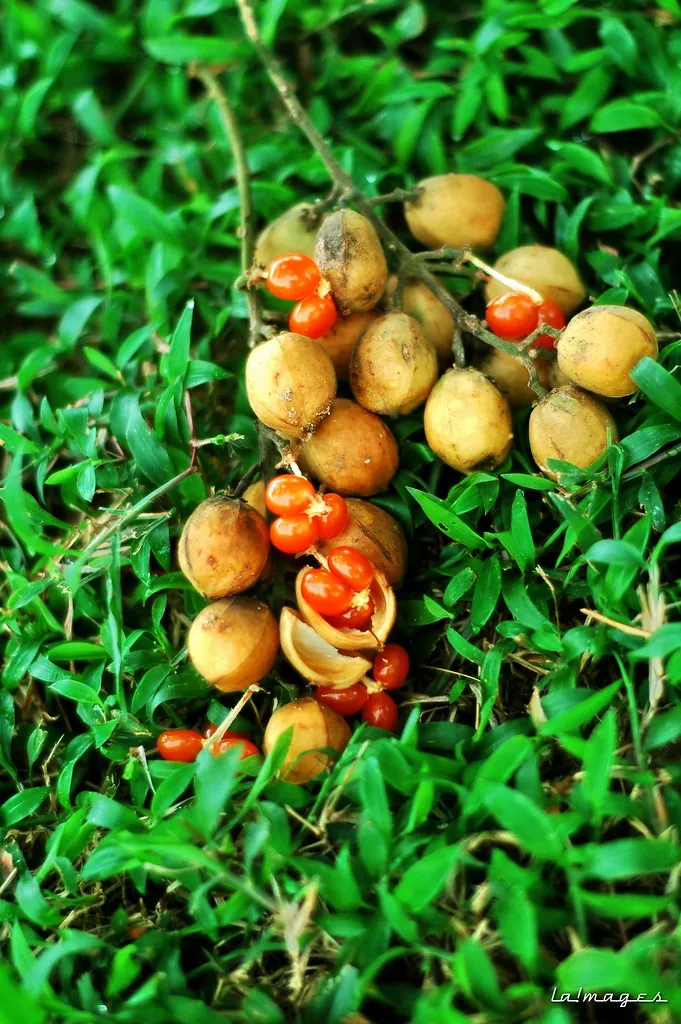
Jentik is a small forest fruit with a yellow-orange shell and red flesh wrapped around flat seeds. Crack it open and eat the flesh in little segments: one fruit in a bunch can taste sweeter, the next more sharply sour.
What it is
The fruit is Baccaurea polyneura, also called jentik-jentik in Malaysia. Each fruit measures about 1–2.6 cm (0.4–1 in) long. Inside are one to three seeds, each with its own fleshy covering. That covering is the part to eat.
The fruits gather along a shared stalk. Open one and the flesh inside is a bright orange-red; even a shell that has dried can still hold good fruit.
Where it comes from
Jentik is native to Thailand, Peninsular Malaysia, Singapore, Sumatra and Borneo. In Aceh, at the northern end of Sumatra, it grows around Gunung Leuser National Park. Among the related Baccaurea fruits eaten by nearby communities, jentik is a local favourite for its taste.
How it's eaten where it grows
In Malaysia, jentik is a fresh snack: the shell opens to release the separate pieces of flesh. A shell that has dried may open with a gentle squeeze.
In southern Thailand, the fruit is known as champuling. One modern preparation is chef Book Boonsmith's champuling salad, made with fruit from Narathiwat.
How it's grown
The tree can reach 30 m (98 ft), with an uneven crown. It grows in tropical forest on hillsides and ridges, and on land built up by river deposits. Sandy and clay soils both support it.
In Aceh, nearly four in ten people asked plant jentik beside other crops for food and income. The flowers gather along the branches. Female flower clusters can be 35 cm (14 in) long, with as many as 50 flowers along a cluster.
When and where you'll find it
In Malaysia it's sold fresh by the kilo in places such as Gurun in Kedah. In southern Thailand it reaches local markets in Narathiwat under the name champuling. Local names change across the region: the same fruit is cham ri in Pattani and cham rai in Nakhon Si Thammarat.
Sources · 6
- Asian Plant: Flora Malesiana species descriptionasianplant.net
- Benchamana et al., Trends in Sciences (2025)tis.wu.ac.th
- Navia, Suwardi and Harmawan, Ethnobotany Research and Applications (2022)ethnobotanyjournal.org
- Singapore National Parks Boardnparks.gov.sg
- Thai PBS, Foodworkthaipbs.or.th
- Ujie Othman, Titian Perjalananujieothman.blogspot.com
Get it near Detroit
What it tastes like
In Aceh, local respondents ranked jentik (Baccaurea polyneura) highest for taste among the Baccaurea species they discussed.
In Aceh, local respondents ranked jentik (Baccaurea polyneura) highest for taste among the Baccaurea species they discussed.
Choose, eat
1ChooseGreen turning yellow
Look for
- Green turning yellow
- Shell splits under pressure
Young fruit is green, turning yellow when ripe; the hard shell splits under pressure to expose orange-red arils.
2EatArils
Eat
ArilsThe fruit is eaten fresh; the wood and other plant material are used separately, not as food.
Detroit, Michigan
When it’s good hereUsual monthsJust arrivedAt their bestLast chanceAll yearWhere it is in its usual monthsToday, Oct 22Grown hereIn season in your stateShips fromIn season where it grows
Cook it
Sources
Sources
Jentik · Fruitopia · checked Sep 23, 2026