Blackberryvariety
Caddo
An Arkansas blackberry bred for eating quality.
Origin · Clarksville, Arkansas, United States
Released 2018
Taste & texture
- Scent
- aromatic
How to spot it
- Weight
- Fruit weight8.0 g
Register-described fruit or cluster measurements in the source trial context; treatment-specific observations are not species-wide constants.
journals.ashs.org ↗Context & source
- /details/observations/1/value/fruit mass g/scope
- Register-described fruit or cluster measurements in the source trial context; treatment-specific observations are not species-wide constants.
- /details/observations/1/value/fruit mass g/observations/0/qualifier
- as_reported
Harvest & storage
- Storage
- outstanding postharvest storage potential and consistent flavor even after storage and rain events
- Harvest
- ripens midseason.
Origin & family
Where Caddo began
Recorded origin
Clarksville, Arkansas
United States
- Institution
- University of Arkansas System Division of Agriculture
- Crossed
- 2004
- Selected
- 2008
- Released
- 2018
Family tree
Loading recorded relationships…
Field notes
- Soluble solids (°Brix)
- 9.8 °Brix
Register-described fruit or cluster measurements in the source trial context; treatment-specific observations are not species-wide constants.
journals.ashs.org ↗Context & source
- /details/observations/1/value/soluble solids brix/scope
- Register-described fruit or cluster measurements in the source trial context; treatment-specific observations are not species-wide constants.
- /details/observations/1/value/soluble solids brix/observations/0/qualifier
- as_reported
Original source notes
Harvest
ripens midseason.Measurements
- Fruit weight (g)
- 8.0
- Soluble solids (°Brix)
- 9.8
Register-described fruit or cluster measurements in the source trial context; treatment-specific observations are not species-wide constants.
Storage
outstanding postharvest storage potential and consistent flavor even after storage and rain eventsPhotos
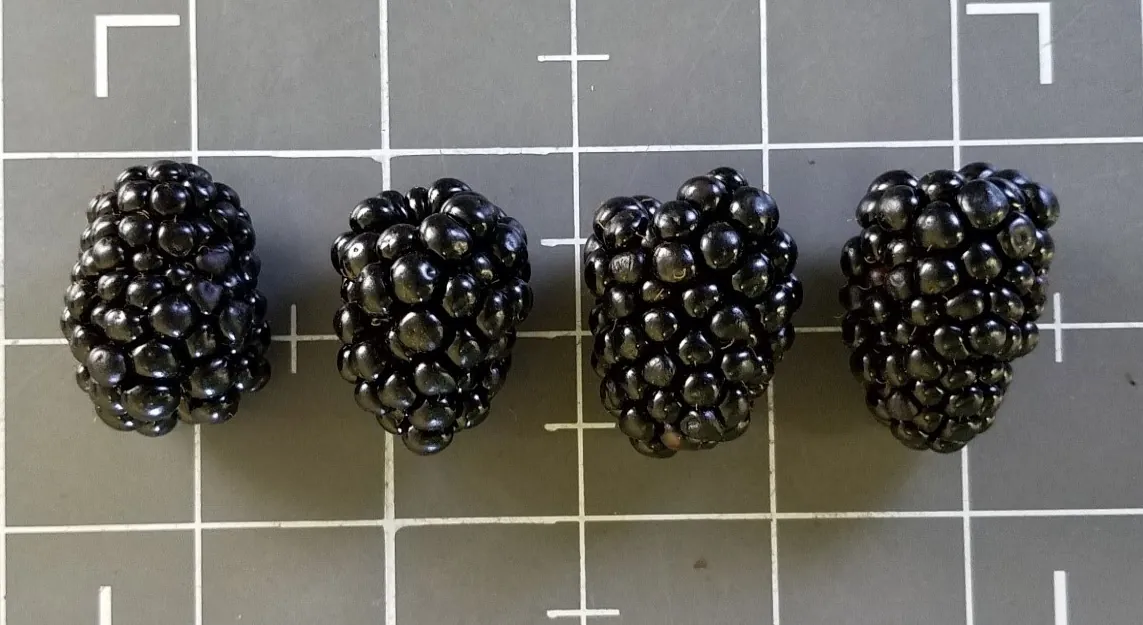
Ark. Agricultural Experiment StationCC BY-SA 2.0 Caddo is a thornless, early-ripening blackberry released by the Division of Agriculture's fruit breeding program in 2019.