Belimbing Dayak
Baccaurea angulata · Phyllanthaceae family
A red, often ridged Baccaurea whose name and shape invite a star-fruit comparison, while its botanical identity and regional food uses tell another story.
Find it near DetroitGet to know it
Belimbing dayak is a red Bornean fruit, often star-like in outline, with white flesh around its seeds. The inside tastes sweet to sweet-sour; the skin has its own place in the kitchen. Its flowers and fruit grow straight from the trunk.
What it is
Baccaurea angulata measures about 3.5–6.7 cm (1.4–2.6 in) long and 2.8–4.5 cm (1.1–1.8 in) across. Inside the red fruit wall are one to three seeds, each wrapped in white edible flesh.
Cut across, many fruits are five- or six-sided. Others are round. A round-fruited form called si lulung grows in East and South Kalimantan, so the star outline belongs to some forms rather than every fruit.
Where it comes from
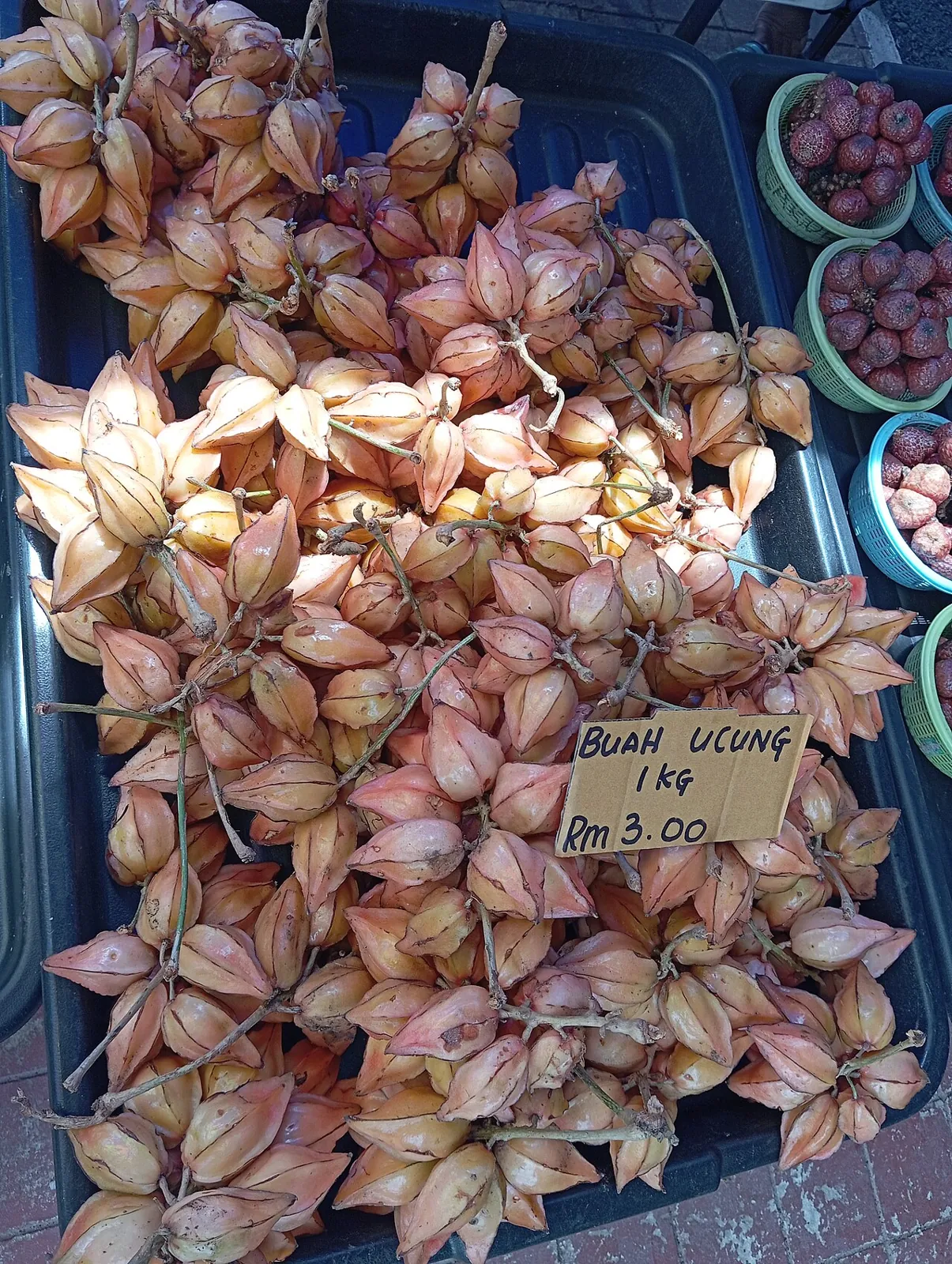
This fruit grows across Borneo, including Indonesian Kalimantan, Malaysian Borneo and Brunei. In Sarawak it goes by uchong and tampoi belimbing as well as belimbing dayak.
Its range also reaches the Natuna Islands. In the villages of Ceruk and Limau Manis, the same species is called belimbing besi. Both the white flesh and the red outer wall are eaten.
How it's eaten where it grows
In West Kalimantan, belimbing dayak is eaten fresh and used as a sour-spicy seasoning. In Central Kalimantan, the fruit goes into fermented drinks. The round-fruited si lulung also supplies a vegetable: its peel.
In Sarawak, the skin can be dried in the sun after the flesh is eaten. The dried pieces become asam keping, used to flavour fish soup. Here the outer wall becomes a cooking ingredient in its own right.
How it's grown
Belimbing dayak grows in mature forest and in forest that has grown back after disturbance, from sea level to about 800 m (2,600 ft). In Kalimantan most trees grow wild in the forest rather than in orchards. Its flowers and fruit sit directly on the trunk.
Flowering usually runs from July to September. Conversion of forest into oil-palm and rubber plantations reduces the habitat of these fruit trees.
When and where you'll find it
In Kalimantan and Natuna, the fruiting season usually falls in October and November. Traditional markets in South Kalimantan and Natuna sell the fresh fruit during the season.
In Sarawak, it has also appeared at Tamu Tani market in Miri. Fresh fruit and sun-dried skin serve different purposes: the flesh is eaten, while the dried skin is kept for cooking.
Get it near Detroit
Sell fruit online? Add your business
What it tastes like
The white aril's flavor ranges from sweet to sweet-sour, varying among fruit forms.
The edible aril and pericarp range from sweet to acid in flavor, varying by fruit form.
Choose, eat
1ChooseRed, ridged fruit
Look for
- Red, ridged fruit
Look for red, ridged fruit, and ask the seller which local preparation it's meant for.
2EatWhite aril · not peel
Eat
White arilNot eaten
PeelThe white aril inside the red fruit wall is eaten separately from the peel; it's also used to make fermented beverages.
Detroit, Michigan
When it’s good here
Season not documented for Michigan.
11 names in 4 languages
- belimbing besiOther name
Cook it
Strange but trueNature
Sources
Photos · 1
Sources
Belimbing Dayak · Fruitopia · checked Sep 22, 2026