African elemi fruit
Also called Schweinfurth's oliveCanarium schweinfurthii
An oily fruit pulp from a large African forest tree, distinct from its resin and timber.
Find it near DetroitGet to know it
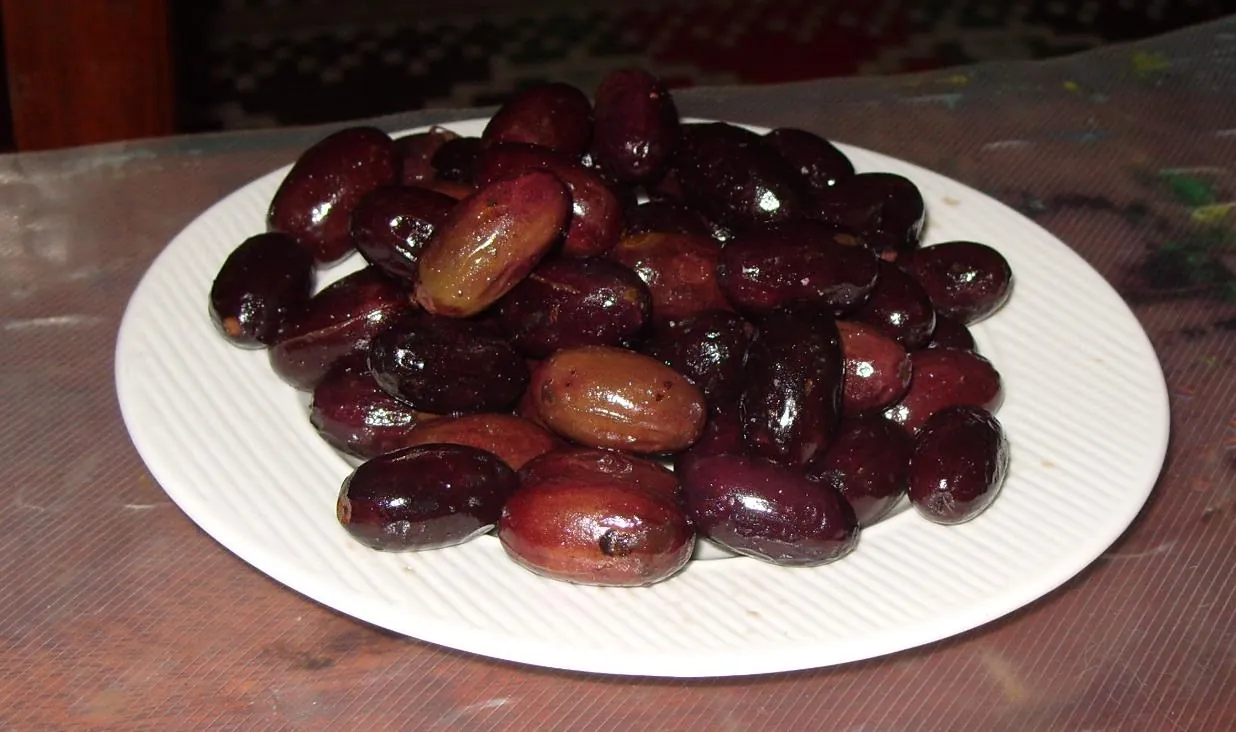
African elemi is a small purple fruit with greenish, oily flesh around a hard stone. In Nigeria it is called atili. A soak in warm water turns the flesh creamy, with an avocado-like richness and a hint of olive.
What it is
The smooth, bluish-purple fruit is about 3–4 cm (1.2–1.6 in) long and 1–2 cm (0.4–0.8 in) thick. Inside sits a hard stone with three angles. The edible outer flesh is slightly green and oily; softening it in warm water makes that flesh easier to eat.
Where it comes from
The fruit comes from Canarium schweinfurthii, a large tree of tropical African forests. Its range stretches from Senegal to west Cameroon and on to Ethiopia, Tanzania and Angola. It grows in rainforest, in gallery forest along rivers and in transitional forest.
How it's eaten where it grows
In Nigeria, atili is a hand-held snack after about ten minutes in lukewarm water. The softened pulp has a rich, creamy texture and an olive-like edge.
In Mutunda and Kiryandongo, in Uganda's Bunyoro-Kitara Kingdom, ripe fruit is eaten straight away or blanched in boiling water for 2–3 minutes to soften the skin and flesh. People usually discard the stone after eating the flesh. Sometimes they roast it, crack it open and eat the kernel inside.
How it's grown
The tree's crown reaches the upper forest canopy, and it carries creamy-white flowers. Farmers often leave it standing on cleared land for its shade. In Bunyoro-Kitara, people gather ripe fruit from the ground or climb and shake the branches to bring it down. Hornbills and elephants carry its seeds through the landscape.
When and where you'll find it
In Nigeria, fresh ripe atili is sold at Daily Market in Pankshin, Plateau State, and one cook bought hers fresh in Jos. Uncooked, it keeps well in the fridge before a brief soak in warm water prepares it for eating.
Sources · 4
- Akello and Agea, East African Journal of Interdisciplinary Studies (2026)journals.eanso.org
- Hazzazi and colleagues, Indian Journal of Pharmaceutical Sciences (2024)ijpsonline.com
- Kitchen Butterfly, Ozoz Sokohkitchenbutterfly.com
- World Agroforestry, Agroforestree Database (2009)apps.worldagroforestry.org
Get it near Detroit
Sell fruit online? Add your business
What it tastes like
Softened atili is creamy and rich, similar to ube and avocado with olive-like undertones.
The outer pulp is greenish and oily. Warm-water softening improves palatability.
Ripen, eat
1RipenWarm-water treatment softens the fruit's texture but does not ripen unripe fruit
Warm-water treatment softens the fruit's texture but does not ripen unripe fruit.
2EatSoftened outer fruit flesh
Eat
Softened outer fruit fleshThe edible part is the softened outer fruit flesh, distinct from the oil, seed kernels and resin extracted from the tree.
Detroit, Michigan
When it’s good here
Season not documented for Michigan.
Cook it
Strange but trueWhere the name came from
Sources
Sources
African elemi fruit · Fruitopia · checked Sep 22, 2026